
SvelteKit vs. Blitz.js
 By SW Habitation
SvelteKit

Blitz.js
So, you know when you want to build a website or app, but doing everything from scratch feels kinda overwhelming? That’s where web frameworks come in. They’re like a ready-made set of tools and building blocks that help you get things up and running way faster. Instead of figuring out every little piece yourself, a framework gives you a solid base to build on, and lets you focus on making something cool.
What is SvelteKit?
SvelteKit is the full-stack application framework built for the Svelte (https://svelte.dev/) UI library. Unlike traditional frameworks that run in the browser, Svelte compiles your code to highly optimized JavaScript at build time which means no virtual DOM, minimal runtime, and ultra-fast performance.
SvelteKit brings everything you need to build web apps into one unified toolchain routing, layouts, API endpoints, server-side rendering (SSR), static site generation (SSG), client-side navigation, and more — all with smart defaults and deep configurability.
Key Features of SvelteKit
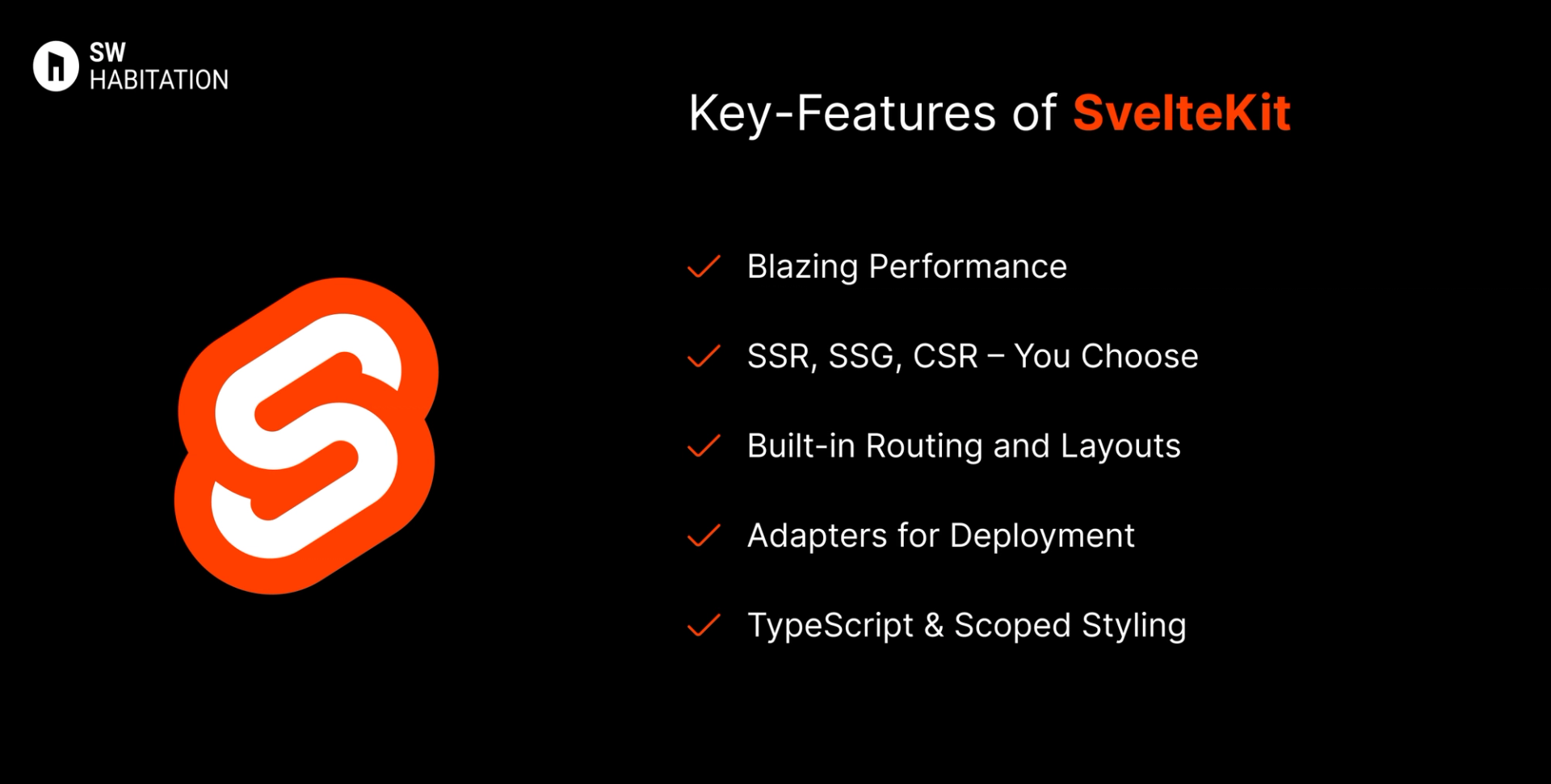
- Blazing Performance: Thanks to Svelte’s compiler-based approach, apps are lean, fast, and minimal.
- SSR, SSG, CSR – You Choose: Build pages using static generation, server rendering, or client-side rendering per route.
- Built-in Routing and Layouts: File-based routing with nested layouts simplifies app structure.
- Adapters for Deployment: Deploy to any platform — Netlify, Vercel, Cloudflare Workers, Node, or static hosting.
- TypeScript & Scoped Styling: Comes with TypeScript support and CSS scoped to components.
Advantages of SvelteKit
- Minimal JavaScript: Only ships what the user needs, no heavy runtime.
- Unified Experience: Routing, layouts, endpoints, and rendering are all built-in.
- Flexible Deployment: Use adapters to deploy anywhere, from edge functions to static hosts.
- Developer Happiness: Clean syntax, fewer abstractions, and fast HMR (Hot Module Reloading).
- Excellent SEO: SSR and pre-rendering make your content crawlable by default.
Disadvantages of SvelteKit
- Smaller Ecosystem: Compared to React or Vue frameworks, it has fewer plugins/modules.
- Learning Curve for Beginners: Svelte syntax is simple, but newcomers may need time to grasp server/client boundaries in SvelteKit.
- Tooling Stability: While stable, SvelteKit is still evolving and may change more rapidly than older frameworks.
- Advanced Use Cases: Handling complex authentication, authorization, or large-scale caching may need custom solutions.
What is Blitz.js ?
Imagine you wanto to build an app but setting up frontend, backend, APIs, database and it feels like overextended right ? That’s where Blitz.js comes in.
Blitz is like this super handy fullstack framework that sits on top of Next.js yup, the one you probably already know. Think of it like Rails but for React. You get Next.js goodies like (SSR, file-based routing, etc.), but Blitz throws in extra magic — like a zero-API data layer, built-in auth system, and easy database integration with Prisma.
Basically it is less boilerplate, more actual building.
Key Features of Blitz.js
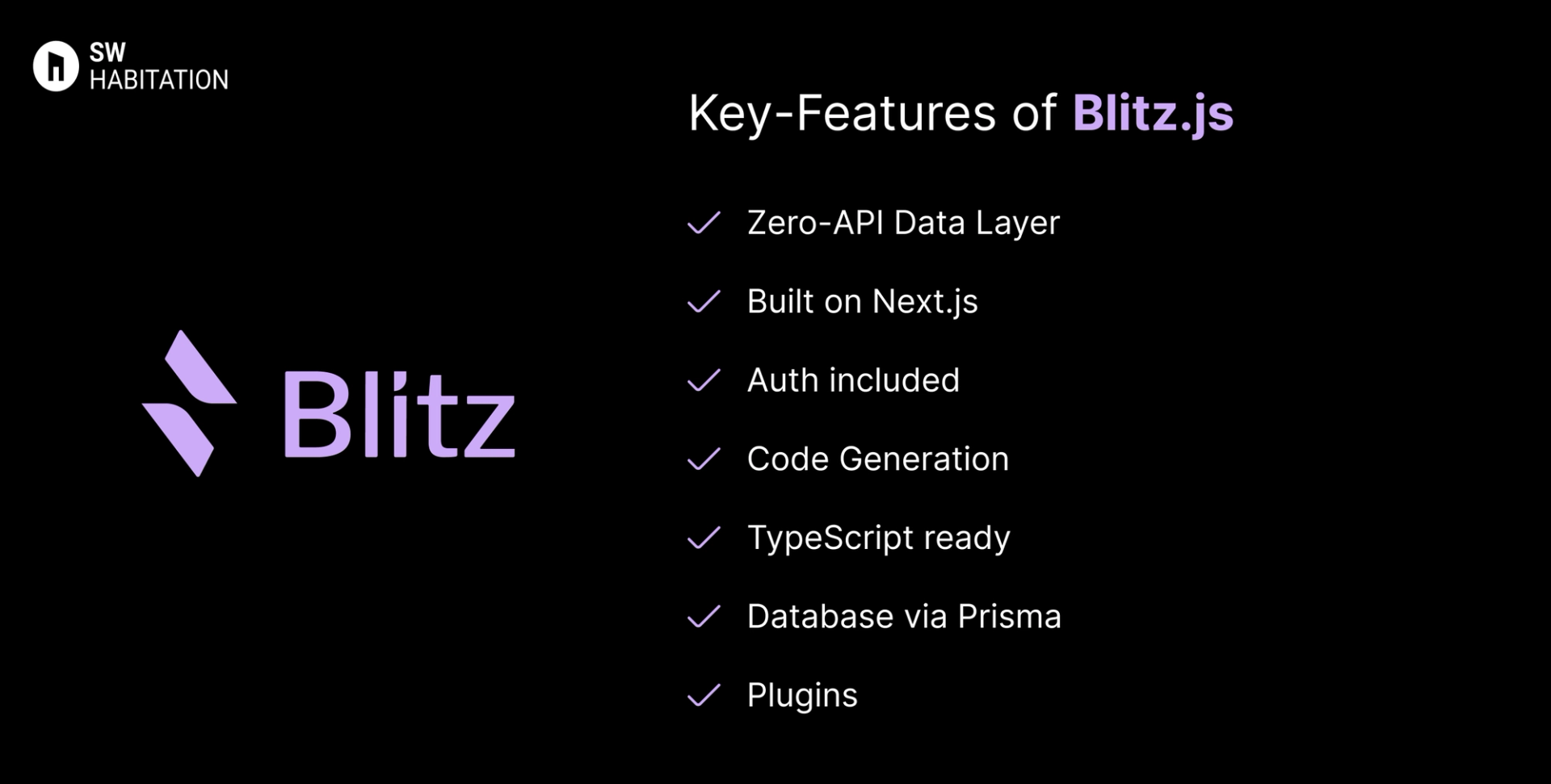
- Zero-API Data Layer – call server functions straight from the client, no need to write API endpoints manually.
- Built on Next.js – so you don’t lose all the SSR/SSG goodness.
- Auth included – login/logout stuff already sorted.
- Code Generation – scaffolding to spin up queries, pages, mutations super fast.
- TypeScript ready – works smooth with TS.
- Database via Prisma – easy database access, feels natural.
- Plugins – add common stuff like Tailwind, auth, etc. with one command.
Advantages of Blitz.js
- All-in-one: You don’t need to glue 10 tools together.
- Boosts productivity: Code scaffolding saves so much time.
- Zero-API layer: Less boilerplate, no boring API wiring.
- Still Next.js inside: You can keep SSR, static exports, etc.
- Databases: Works great with Prisma and SQL databases.
- Community is small but passionate: New recipes, ideas keep coming.
Disadvantages of Blitz.js
- Might be overkill: If all you need is a tiny static site, Blitz is too heavy.
- New learning curve: You need to understand queries/mutations instead of normal APIs.
- Smaller community: Not as huge as Next.js, so fewer tutorials and resources.
- Dependent on Next.js: Since it’s built on Next, any big shift in Next.js affects Blitz.
- Still maturing: Some features and ecosystem tools are not as polished as older frameworks.
Comparison Between SvelteKit vs Blitz.js
Use Cases of SvelteKit
- Technical Blogs & Portfolios
- Dashboards & SaaS Platforms
- Marketing Websites
- E-commerce Sites
- APIs & Endpoints
Use Cases of Blitz.js
- SaaS apps → logins, dashboards, subscriptions, etc.
- Startups → ship MVPs super quick without boilerplate APIs.
- E-commerce → product pages, cart, checkout flows.
- Internal tools → admin dashboards, CRMs, reporting tools.
- Fullstack React apps → whenever you want frontend + backend + DB together.
Other Resources
Conclusion
Web frameworks make building websites and apps a whole lot easier. Whether you’re working on a personal project or something big for work, they help with the heavy lifting—like routing, design structure, and how everything connects.
With support for things like server-side rendering, optimized performance, and developer-friendly features, these tools let you create faster, smarter, and cleaner websites. Just pick the one that fits your style, and start building something awesome 🚀
Frequently asked questions
Is SvelteKit production-ready?
Yes. SvelteKit reached 1.0 stable in late 2022 and is now considered production-ready. Many companies are already using it for production apps.
Can I migrate my existing Svelte app to SvelteKit?
Yes. You can move your Svelte components into a SvelteKit project and then set up routing, data loading, and server logic. The migration is straightforward but may require some restructuring.
Does SvelteKit support TypeScript?
Yes. TypeScript support is built-in. You can enable it when creating your project with npm create svelte@latest.
Which rendering modes does SvelteKit support?
SvelteKit supports SSR (Server-Side Rendering), SSG (Static Site Generation), CSR (Client-Side Rendering), and even hybrid setups in a single app.
Is Blitz.js just Next.js with extra stuff?
Pretty much, yeah. It’s Next.js at the core but with fullstack tools (auth, DB, scaffolding, etc.) added on top.
Do I have to use Prisma with Blitz?
Nope. Prisma is the default, but you can hook up whatever database you like.
Can I still use REST or GraphQL?
Yup, you can, but Blitz’s “zero-API data layer” usually makes it unnecessary.
Is Blitz production-ready?
Totally. People already use it in production, but yeah, smaller ecosystem than React/Next.
Who should avoid Blitz?
If you’re just making a small static blog or portfolio → probably overkill. Blitz shines for bigger apps.
Next blog that you can read...
By SW Habitation