
SolidJS vs. Qwik
 By SW Habitation
SolidJS

Qwik
So, you know when you want to build a website or app, but doing everything from scratch feels kinda overwhelming? That’s where web frameworks come in. They’re like a ready-made set of tools and building blocks that help you get things up and running way faster. Instead of figuring out every little piece yourself, a framework gives you a solid base to build on, and lets you focus on making something cool.
What is SolidJS?
SolidJS is a modern reactive JavaScript library for building fast, declarative user interfaces. Inspired by React, it focuses on fine-grained reactivity and compiles templates to efficient JavaScript code, making applications both lightweight and performant.
Unlike React, SolidJS doesn’t use a virtual DOM. Instead, it updates only the parts of the DOM that change, resulting in better performance and smaller bundle sizes.
Key Features of SolidJS
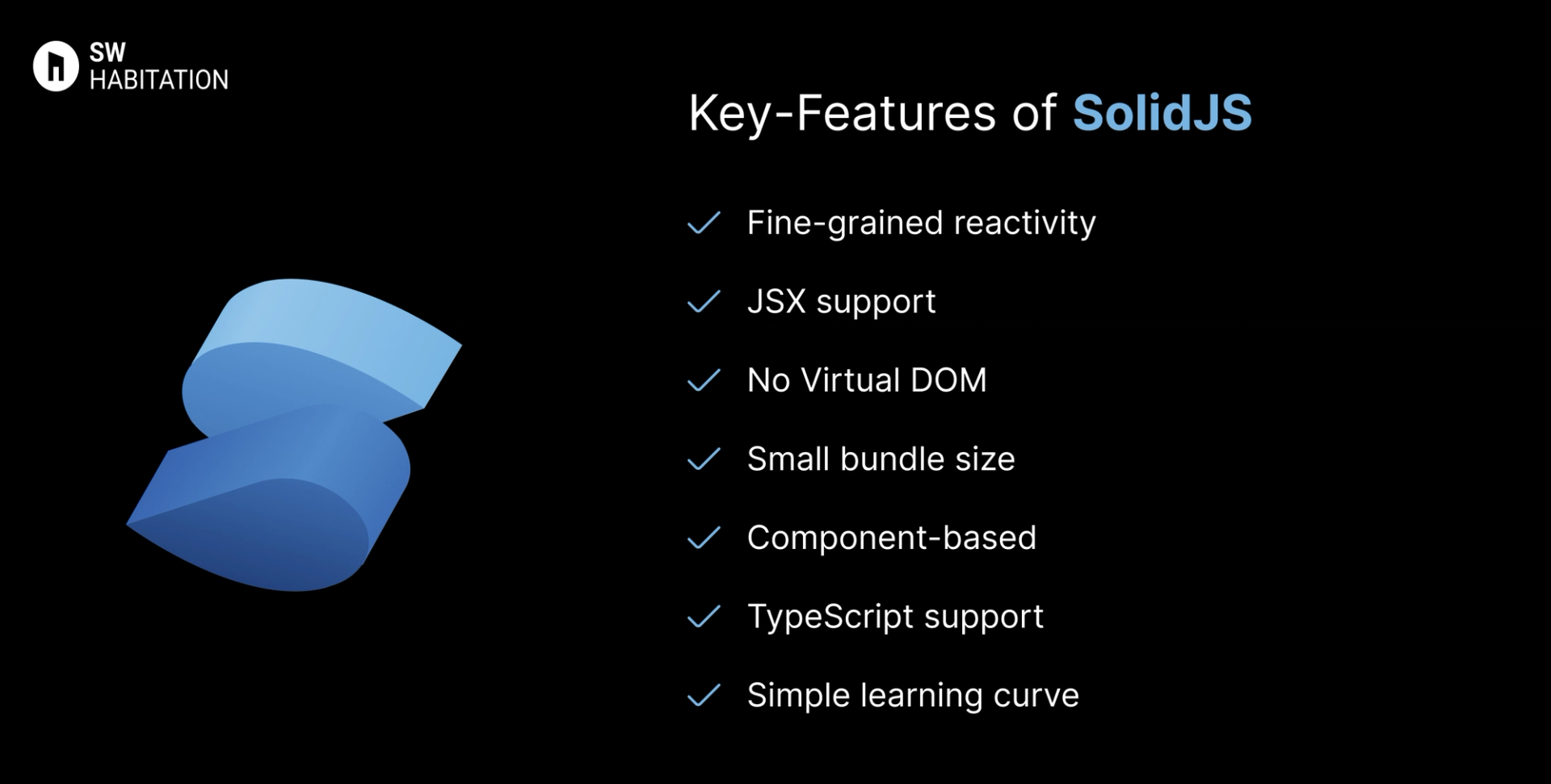
- Fine-grained reactivity: Updates DOM precisely where needed, without re-rendering entire components.
- JSX support: Uses JSX syntax, making it easy for React developers to learn.
- No Virtual DOM: Direct DOM updates for better performance and lower memory usage.
- Small bundle size: Lightweight, leading to faster load times.
- Component-based: Similar to React, it uses reusable, composable components.
- TypeScript support: First-class TypeScript support for type safety.
- Simple learning curve: Easy for developers familiar with React or modern frontend frameworks.
Advantages of SolidJS
- Performance: Outperforms most frameworks thanks to fine-grained reactivity and DOM compilation.
- React-Like Syntax: Easy for React developers to adopt.
- Small & Lightweight: Tiny runtime with minimal overhead.
- Flexible State Management: Built-in signals and stores reduce the need for external libraries.
- SSR Ready: Great for SEO-driven apps like blogs or e-commerce.
Disadvantages of SolidJS
- Smaller Ecosystem: Fewer libraries, tools, and community packages compared to React or Vue.
- Learning Curve: React developers may need to unlearn Virtual DOM patterns.
- Evolving Framework: Still relatively young, so some integrations (like CMS or UI libraries) may require custom solutions.
- Smaller Community: Less support and fewer tutorials compared to React.
What is Qwik?
Qwik is a next-generation JavaScript framework designed for instant-loading web apps by using resumability instead of hydration. Unlike React, Vue, or Solid, which re-render components on the client, Qwik ships minimal JavaScript and resumes execution exactly where the server left off.
This makes Qwik ideal for ultra-fast, SEO-friendly apps with near-instant Time-to-Interactive (TTI), even on slow networks or devices.
Key Features of Qwik
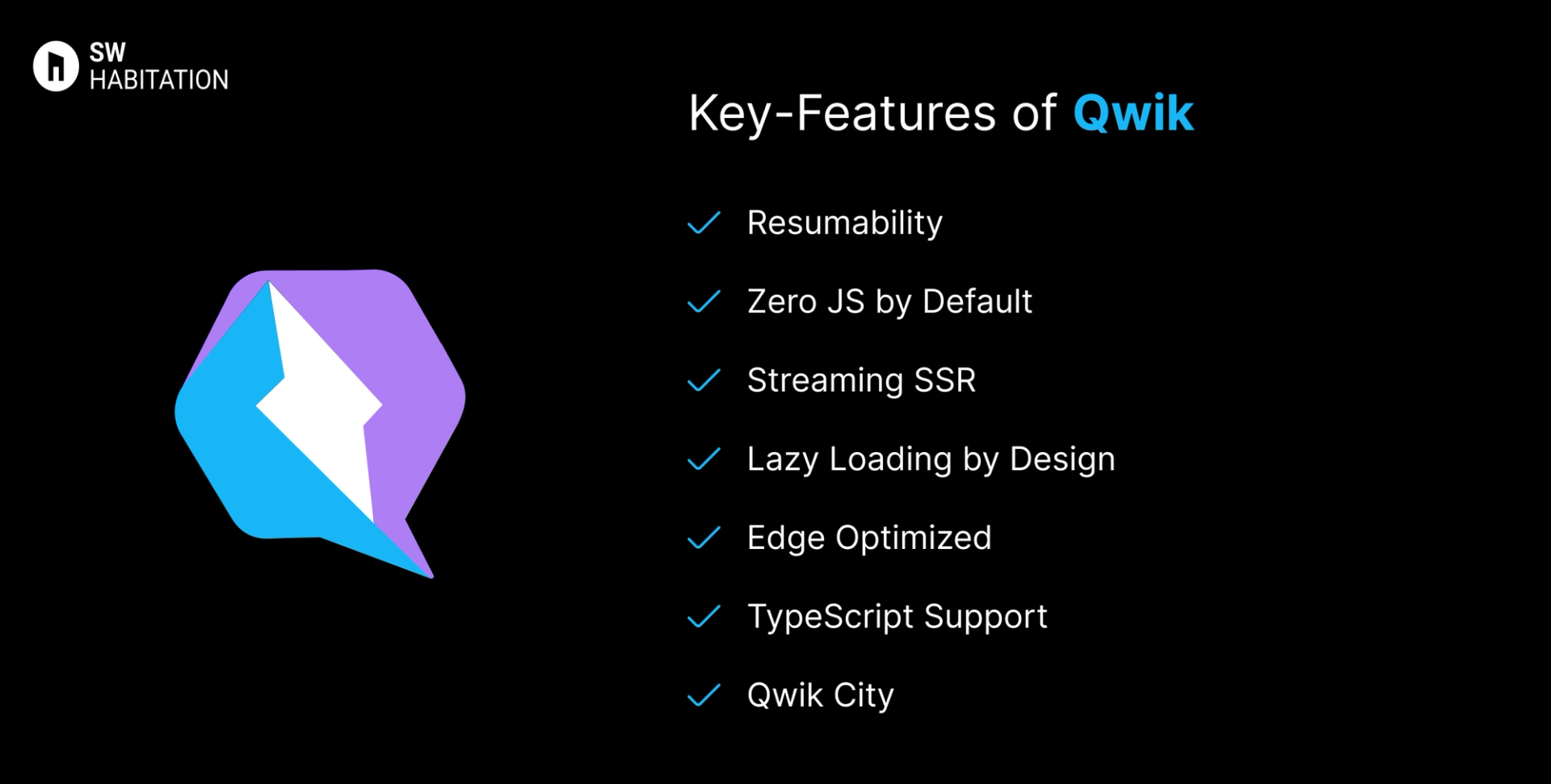
- Resumability: No hydration,resumes app state instantly on the client.
- Zero JS by Default: Ships only the JavaScript needed for interaction.
- Streaming SSR: Server-rendered HTML streams for faster load times.
- Lazy Loading by Design: Every component is lazy-loaded automatically.
- Edge Optimized: Runs efficiently on modern edge platforms.
- TypeScript Support: Works seamlessly with TypeScript.
- Qwik City: Official meta-framework with routing, SSR, and middleware.
Advantages of Qwik
- Blazing Fast: Instant interactivity without hydration.
- Minimal JavaScript: Loads only what’s necessary.
- SEO-Friendly: Pre-rendered HTML with resumability.
- Qwik City: Built-in file-based routing and full-stack features.
- Future-Proof: Designed for edge-first and low-bandwidth devices.
Disadvantages of Qwik
- New Ecosystem: Still growing, fewer libraries compared to React/Vue.
- Learning Curve: Resumability and lazy-loading model may feel new.
- Tooling Maturity: Some integrations (like CMS/auth) need custom setup.
- Smaller Community: Not as large as React or Angular yet.
Comparison Between SolidJS vs Qwik
Use Cases of SolidJS
- E-commerce Apps: High-performance, dynamic UIs with fast updates.
- Blogs & Portfolios: SEO-friendly with SSR support.
- Dashboards: Real-time data updates with fine-grained reactivity.
- Interactive SPAs: Complex applications with minimal overhead.
- Cross-Platform Apps: With Solid Start (meta-framework), you can build full-stack apps.
Use Cases of Qwik
- Landing Pages: Instant-loading, SEO-friendly marketing sites.
- E-commerce: Fast product pages with lazy-loaded interactivity.
- Dashboards: Data-heavy apps that benefit from resumability.
- PWAs: Progressive Web Apps with instant interactivity.
- Edge-Native Apps: Apps deployed on edge networks like Vercel or Netlify.
Other Resources
Conclusion
Web frameworks make building websites and apps a whole lot easier. Whether you’re working on a personal project or something big for work, they help with the heavy lifting—like routing, design structure, and how everything connects.
With support for things like server-side rendering, optimized performance, and developer-friendly features, these tools let you create faster, smarter, and cleaner websites. Just pick the one that fits your style, and start building something awesome 🚀
Frequently asked questions
Is SolidJS better than React?
SolidJS is faster, but React has a bigger ecosystem.
Does SolidJS use JSX?
Yes, just like React.
Can I use SolidJS with TypeScript?
Yes, it has full TypeScript support.
Can I use npm packages with SolidJS?
Yes, but React-specific libraries may not work.
Does SolidJS support SSR?
Yes, SolidJS has built-in SSR support.
Is Qwik better than React?
Faster in load time and interactivity, but React has a larger ecosystem.
Does Qwik use JSX?
Yes, Qwik uses JSX/TSX syntax.
Can I use Qwik with TypeScript?
Yes, it has built-in TypeScript support.
Is Qwik production-ready?
Yes, it’s stable and used in production, but still growing.
What is Qwik City?
The official meta-framework for routing, SSR, and middleware.
When should I use Qwik?
When you need ultra-fast, SEO-optimized apps with instant interactivity.