
Remix vs. Meteor.js
 By SW Habitation
Remix

Meteor.js
So, you know when you want to build a website or app, but doing everything from scratch feels kinda overwhelming? That’s where web frameworks come in. They’re like a ready-made set of tools and building blocks that help you get things up and running way faster. Instead of figuring out every little piece yourself, a framework gives you a solid base to build on, and lets you focus on making something cool.
What is Remix ?
Remix is a React-based full-stack framework that focuses on server-side rendering (SSR) and progressive enhancement. Unlike static site generators, Remix loads data on the server and sends only what’s needed to the browser, making apps feel lightning-fast. It’s built to optimize UX, performance, and accessibility while giving developers a structured and scalable way to build web applications.
Key Features of Remix
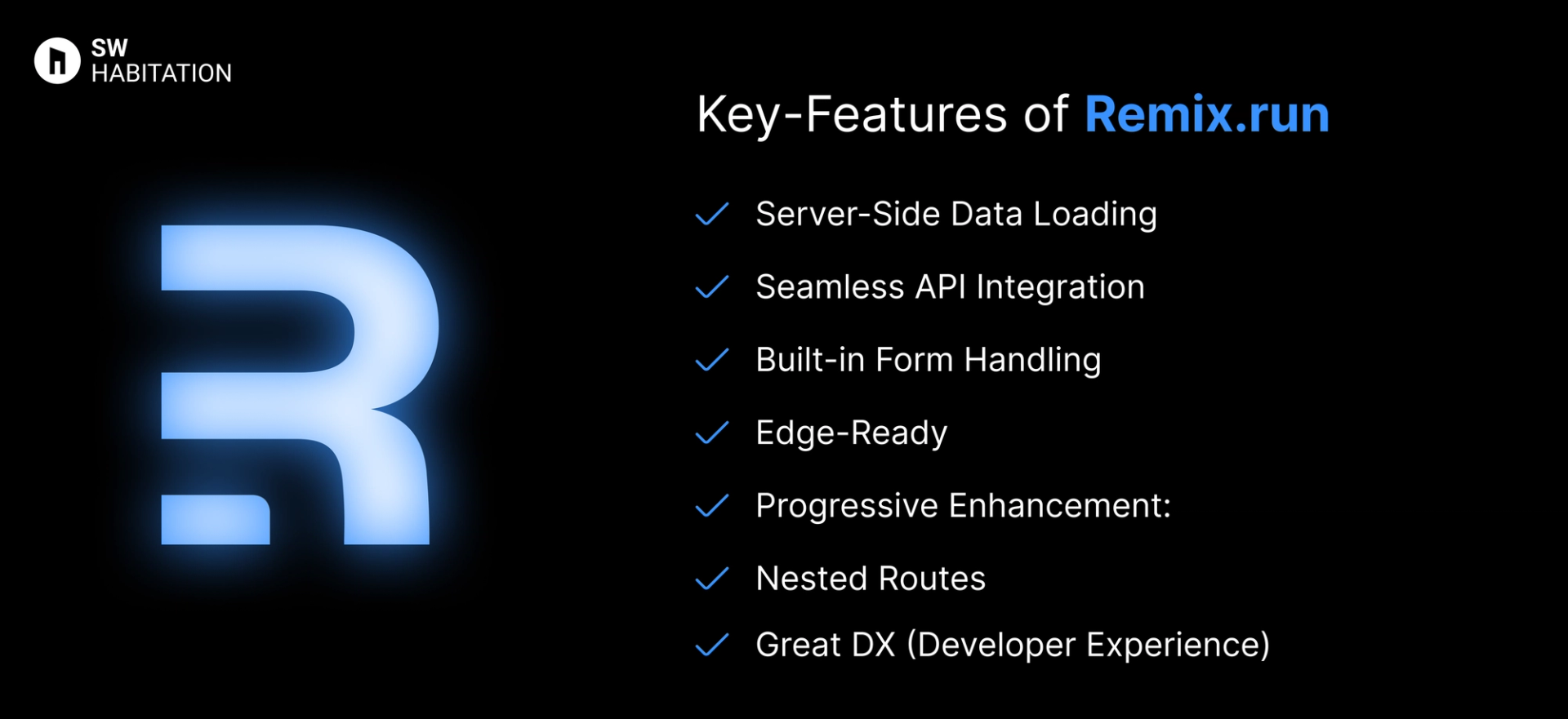
- Server-Side Data Loading: Fetch data on the server before sending it to the client, reducing unnecessary API calls.
- Seamless API Integration: Easily connect with any backend or database.
- Built-in Form Handling: No need for external libraries like React Query – Remix handles form submissions naturally.
- Edge-Ready: Works seamlessly on edge computing platforms like Vercel and Cloudflare Workers.
- Progressive Enhancement: Apps work even if JavaScript is disabled, ensuring a smooth user experience.
- Nested Routes: Create modular components that load only the data they need, improving performance.
- Great DX (Developer Experience): Simple routing, fast refresh, and minimal boilerplate.
Advantages of Remix.run
- Works with Any Backend: Remix doesn’t lock you into a specific database or API.
- Improved UX: Fine-tuned loading strategies create a smoother browsing experience.
- Scalable: Works for both small projects and enterprise-grade applications.
- Great SEO: Unlike SPAs, Remix ensures search engines can index content properly.
- Fast and Efficient: Server-side rendering optimizes performance and reduces unnecessary re-renders.
Disadvantages of Remix.run
- Hosting Considerations: Requires a backend environment (like Node.js), so it’s not ideal for purely static sites.
- Newer Ecosystem: Compared to Next.js, Remix has fewer third-party integrations.
- Learning Curve: If you’re used to client-side React apps, SSR might take some time to grasp.
What is Meteor.js ?
Meteor.js is a full-stack JavaScript framework that lets you build modern web apps super fast. It’s designed so that frontend, backend, and database all work together seamlessly. One of its coolest features is real-time updates anything you change on the server automatically shows up on the client without refreshing the page.
You can use React, Angular, Vue, or Blaze for the UI, and Meteor handles syncing the data automatically using a client-side cache called Minimongo. This makes it perfect for apps like chat platforms, dashboards, collaborative tools, or any app that needs live updates.
Meteor also comes with a lot of packages via Atmosphere.js, which makes adding new features easier, and you can deploy your app quickly using Meteor Galaxy or any Node server. Basically, Meteor is great for devs who want to prototype fast, ship MVPs, or build apps with instant updates without spending tons of time wiring everything together manually.
Key Features of Meteor.js
- Full-stack framework : Handles frontend, backend, and database together.
- Real-time updates : Changes on server reflect on client instantly without refresh.
- Supports multiple UI libraries : Works with React, Angular, Vue, or Blaze.
- Built-in data layer : Uses Minimongo for fast client-side caching.
- Easy deployment : Can deploy apps quickly with Meteor Galaxy or any Node server.
- Package ecosystem : Has Atmosphere.js for extra packages.
- Hot code reload : See changes instantly during development without restarting the app.
Advantages of Meteor.js
- Real-time by default : No extra code needed for instant updates.
- Full-stack in one : Frontend, backend, DB all together.
- Rapid prototyping : Build MVPs very fast.
- Hot reload : Makes development smooth and fun.
- Flexible UI : Use React, Angular, Vue, or Blaze.
- Active ecosystem : Packages on Atmosphere.js help extend functionality.
- Good community support : Tutorials, forums, and guides available.
Disadvantages of Meteor.js
- Not great for huge apps : Can get messy with very large projects.
- Smaller ecosystem than Node/React : Fewer third-party packages overall.
- Learning curve : Real-time concepts and Minimongo can confuse beginners.
- Performance issues : Large-scale apps need optimization for speed.
- Less opinionated structure : Can lead to inconsistent project organization.
- Database tied to MongoDB : Mainly works best with MongoDB.
- Updates Sometimes tricky : Breaking changes possible when upgrading Meteor version.
Comparison Between Remix vs Meteor.js
Use Cases of Remix
- Interactive Dashboards: Efficient data fetching makes Remix ideal for real-time applications.
- E-commerce Sites: Fast data fetching and seamless UI interactions.
- Content-Rich Websites: Great SEO and progressive enhancement ensure content is always accessible.
- SaaS Applications: Server-rendered pages reduce loading times.
Use Cases of Meteor.js
- Chat apps : Real-time messaging works out-of-the-box.
- Dashboards : Live data dashboards with instant updates.
- Collaborative apps : Multi-user editing apps, like Trello clone.
- MVPs & prototypes : Rapidly build and test ideas.
- Games & social apps : Real-time updates make it smooth.
Other Resources
Conclusion
Web frameworks make building websites and apps a whole lot easier. Whether you’re working on a personal project or something big for work, they help with the heavy lifting—like routing, design structure, and how everything connects.
With support for things like server-side rendering, optimized performance, and developer-friendly features, these tools let you create faster, smarter, and cleaner websites. Just pick the one that fits your style, and start building something awesome 🚀
Frequently asked questions
Can I use Remix with my existing app?
Yes, absolutely Remix can be integrated into existing apps or used to build new ones. It works well with other tools and technologies, giving you flexibility.
Where can I host a Remix app?
You can host Remix apps anywhere that supports modern JavaScript and Node.js, like Vercel, Netlify, or traditional cloud platforms like AWS or Heroku.
How does Remix improve performance?
Remix focuses on delivering minimal JavaScript to the browser, using server-side rendering, and optimizing page loads. It also prioritizes fast data fetching and content delivery.
Is Meteor.js only for MongoDB?
Mostly yes. MongoDB is the primary database, but adapters exist for others.
Can I use React with Meteor?
Yes, React, Angular, Vue, or Blaze can be used.
Is Meteor good for production apps?
Yes, but for very large apps you might need careful optimization.
Does Meteor support real-time apps?
Absolutely. Real-time updates are built-in by default.
Why choose Meteor.js?
If you want full-stack, real-time apps fast with minimal setup, Meteor is perfect.
Next blog that you can read...
By SW HabitationBy SW Habitation