
Open Props vs. Tailwind CSS
 By SW Habitation
Open Props

Tailwind CSS
You know how building a website can feel like a lot, especially when you’re trying to style every little thing yourself? Buttons, forms, layouts… it adds up fast. That’s where UI frameworks really save the day. They give you a bunch of premade design elements that you can just drop in and go. It’s like having a design starter pack that helps your site look clean and professional, without spending forever tweaking the details.
What is Open Props?
Open Props is a modern CSS framework built entirely around CSS custom properties (variables). Instead of sending prebuilt UI components or heavy utility classes, it provides a set of reusable design tokens that you can apply anywhere. Think of it as a toolbox of modern CSS features rather than a ready-made UI kit.
It’s not a traditional framework like Bootstrap or Tailwind. Instead, it’s closer to a design system foundation—a library of variables for colors, typography, shadows, gradients, animations, spacing, and sizes. Developers can use these variables in raw CSS, Sass, or even combine them with other frameworks.
Because it’s framework-agnostic, Open Props works well with plain HTML, React, Vue, Angular, or even with utility-first libraries like Tailwind.
Key Features of Open Props
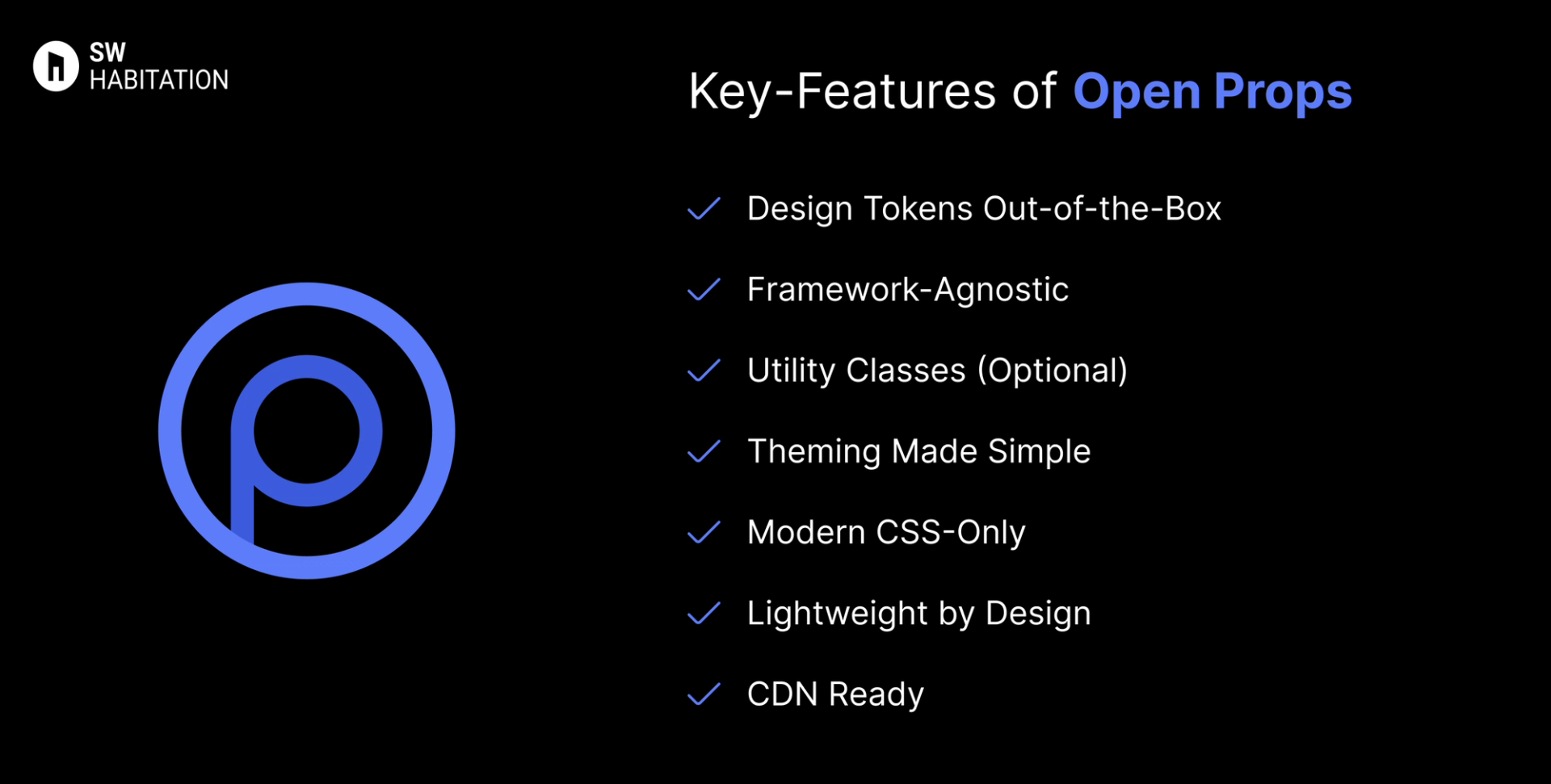
- Design Tokens Out-of-the-Box: Colors, gradients, fonts, shadows, borders, animations, spacing.
- Framework-Agnostic: Works with vanilla CSS, SCSS, PostCSS, Tailwind, or any frontend setup.
- Utility Classes (Optional): Comes with optional helpers like margin: var(--size-3).
- Theming Made Simple: Supports dark/light mode with just a few variable overrides.
- Modern CSS-Only: No JavaScript, only pure CSS properties.
- Lightweight by Design: Extremely small bundle size compared to component-heavy frameworks.
- CDN Ready: Drop in via a <link> or import with NPM.
Advantages of Open Props
- Flexible: Can be used standalone or alongside other CSS frameworks.
- Theming Support: Switch to dark mode or brand colors by redefining tokens.
- Beginner-Friendly: Easy for anyone who already knows CSS variables.
- Ultra Lightweight: Just variables, no unnecessary bloat.
- Encourages Best Practices: Pushes developers towards scalable, token-based design systems.
- Easy to Customize: Override props once to apply across your project.
Disadvantages of Open Props
- Small Community: Limited templates, examples, and resources compared to Bootstrap/Tailwind.
- Not Plug-and-Play: Great for design systems, but not ideal if you want instant UI.
- No Prebuilt Components: You’ll need to design buttons, modals, navbars yourself.
- Challenging Learning Curve for Beginners: Requires understanding of CSS variables and design tokens.
What is Tailwind CSS?
Tailwind CSS is a utility-first CSS framework that allows developers to design user interfaces by applying atomic utility classes directly in markup. Rather than offering prebuilt UI components, it empowers developers with building blocks to create fully customized and performance-optimized designs.
Key features of Tailwind CSS
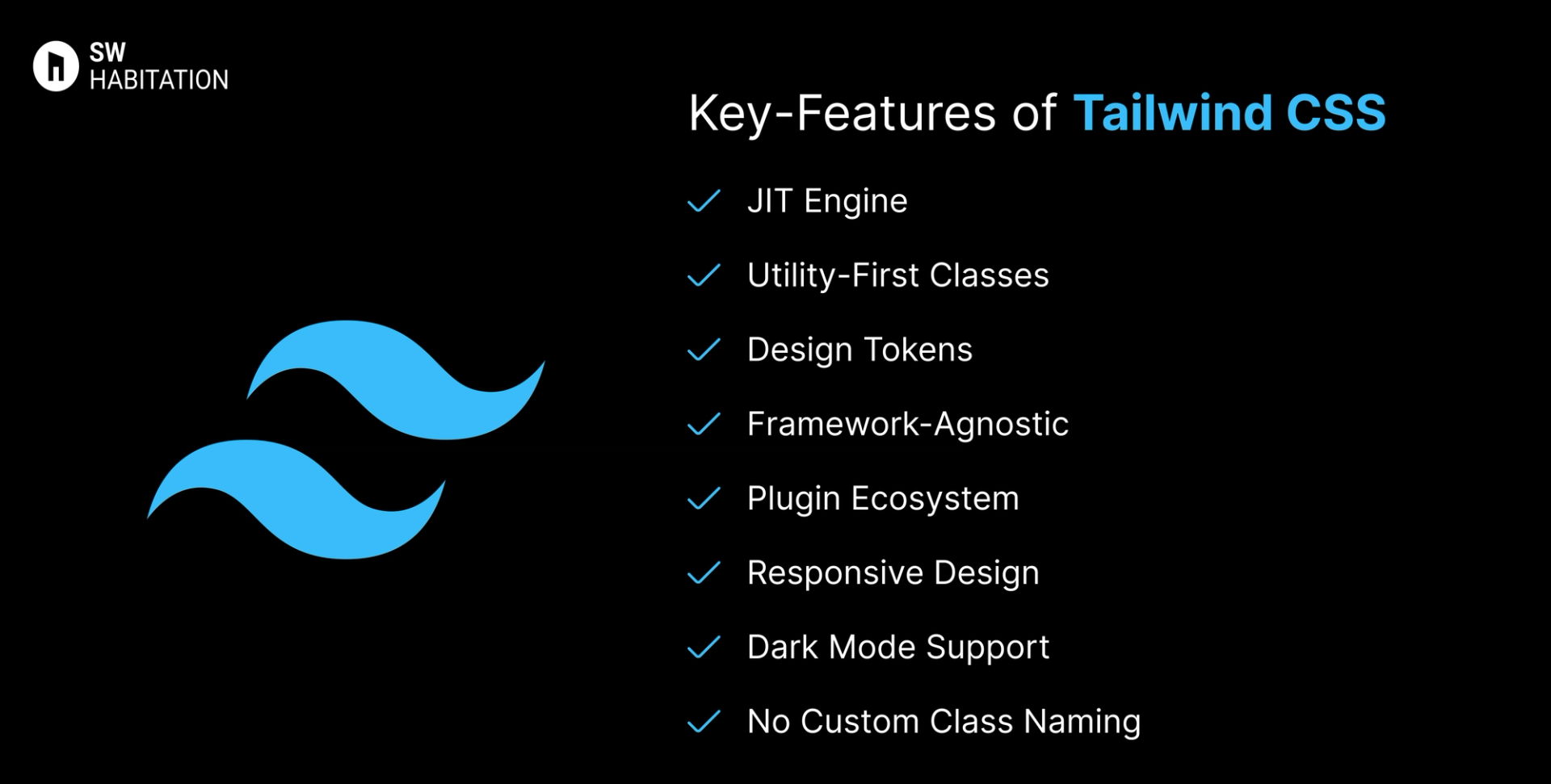
- JIT Engine: Builds only the styles you use, resulting in small and fast CSS bundles.
- Utility-First Classes: Apply styling via single-purpose classes like p-4, text-sm, or bg-red-500.
- Design Tokens: Consistent spacing, sizing, and color scales across your design.
- Framework-Agnostic: Compatible with React, Vue, Svelte, Angular, and plain HTML.
- Plugin Ecosystem: Extend with official and community plugins for forms, typography, etc.
- Responsive Design: Built-in mobile-first breakpoints using prefixes like sm:, md: etc.
- Dark Mode Support: Easily implement dark mode using dark: variants or media strategies.
- No Custom Class Naming: Skip naming headaches now you can directly compose your layout visually with utility classes.
Advantages of Tailwind CSS
- No CSS Context Switching: All styling lives right in the markup — no need to jump between HTML and CSS.
- Framework Independence: Works with any modern frontend stack without restrictions.
- Design Control: Gives developers full control over the UI without being locked into component styling.
- Highly Customizable: Themes, spacing, fonts, and colors can be tailored to any brand or project.
- Consistent Design Language: Utility classes encourage consistency across the app.
- Great Ecosystem: Strong community support, tons of plugins, UI kits, and templates available.
- Performance Optimized: Small CSS bundles with tree-shaking and JIT mean faster load times.
Disadvantages of Tailwind CSS
- Verbose HTML: HTML/JSX can become cluttered with many class names.
- Initial Setup Time: Customizing themes and config files may be overkill for small projects.
- Steep Learning Curve: Takes time to get used to utility classes, especially for those used to traditional CSS.
- No Built-in Components: Unlike Bootstrap or Chakra UI, you need to build components from scratch.
- Harder for Designers: Designers unfamiliar with utility-first might find it harder to collaborate.
Comparison Between Open Props vs Tailwind CSS
Use Cases of Open Props
- Developers who want flexibility without being tied to Tailwind/Bootstrap.
- Building custom design systems from scratch.
- Lightweight personal projects or portfolios.
- Teams that want theming and scalability at the token level.
- Adding modern CSS tokens to legacy projects.
Use Cases of Tailwind CSS
- High-performance marketing pages
- Web apps that need full control over UX and design
- Custom-designed SaaS dashboards
- Design systems with strict branding guidelines
- Mobile-first responsive web apps
Other Resources
Conclusion
UI frameworks make building a polished website way easier. Whether you're working on something simple or a big project, they help you get things looking just right without having to stress over every little design decision. With ready-to-use components, responsive layouts, and modern styles, you can build faster and smarter.
So, pick one that works for you, and start creating a site that looks amazing from the get-go.
Frequently asked questions
Is Open Props a CSS framework like Bootstrap or Tailwind?
No, Open Props is not a framework. It’s a collection of CSS custom properties (design tokens).
Can I customize the values in Open Props?
Yes, Open Props variables can be overridden to fit your own design system.
Does Open Props make my CSS heavy?
No, Open Props is lightweight and you can import only the modules you need.
Does Open Props work with React, Vue, Next.js, etc.?
Yes, Open Props is framework-agnostic and works anywhere CSS works.
Is Open Props safe to use in production?
Yes, Open Props is stable, actively maintained, and widely used in real projects.
Is Tailwind a CSS framework like Bootstrap?
It's more of a utility-based toolkit. While Bootstrap gives you components, Tailwind gives you building blocks.
Can I use Tailwind with React?
Yes, Tailwind works seamlessly with React, Vue, Svelte, and even plain HTML.
How is Tailwind different from inline styles?
Tailwind uses a design system with responsive variants and consistent scaling — unlike random inline styles.
Does it support dark mode out of the box?
Yes. You can use dark: variants or configure custom strategies.