
Meteor.js vs. Nuxt js
 By SW Habitation
Meteor.js

Nuxt js
So, you know when you want to build a website or app, but doing everything from scratch feels kinda overwhelming? That’s where web frameworks come in. They’re like a ready-made set of tools and building blocks that help you get things up and running way faster. Instead of figuring out every little piece yourself, a framework gives you a solid base to build on, and lets you focus on making something cool.
What is Meteor.js ?
Meteor.js is a full-stack JavaScript framework that lets you build modern web apps super fast. It’s designed so that frontend, backend, and database all work together seamlessly. One of its coolest features is real-time updates anything you change on the server automatically shows up on the client without refreshing the page.
You can use React, Angular, Vue, or Blaze for the UI, and Meteor handles syncing the data automatically using a client-side cache called Minimongo. This makes it perfect for apps like chat platforms, dashboards, collaborative tools, or any app that needs live updates.
Meteor also comes with a lot of packages via Atmosphere.js, which makes adding new features easier, and you can deploy your app quickly using Meteor Galaxy or any Node server. Basically, Meteor is great for devs who want to prototype fast, ship MVPs, or build apps with instant updates without spending tons of time wiring everything together manually.
Key Features of Meteor.js
- Full-stack framework : Handles frontend, backend, and database together.
- Real-time updates : Changes on server reflect on client instantly without refresh.
- Supports multiple UI libraries : Works with React, Angular, Vue, or Blaze.
- Built-in data layer : Uses Minimongo for fast client-side caching.
- Easy deployment : Can deploy apps quickly with Meteor Galaxy or any Node server.
- Package ecosystem : Has Atmosphere.js for extra packages.
- Hot code reload : See changes instantly during development without restarting the app.
Advantages of Meteor.js
- Real-time by default : No extra code needed for instant updates.
- Full-stack in one : Frontend, backend, DB all together.
- Rapid prototyping : Build MVPs very fast.
- Hot reload : Makes development smooth and fun.
- Flexible UI : Use React, Angular, Vue, or Blaze.
- Active ecosystem : Packages on Atmosphere.js help extend functionality.
- Good community support : Tutorials, forums, and guides available.
Disadvantages of Meteor.js
- Not great for huge apps : Can get messy with very large projects.
- Smaller ecosystem than Node/React : Fewer third-party packages overall.
- Learning curve : Real-time concepts and Minimongo can confuse beginners.
- Performance issues : Large-scale apps need optimization for speed.
- Less opinionated structure : Can lead to inconsistent project organization.
- Database tied to MongoDB : Mainly works best with MongoDB.
- Updates Sometimes tricky : Breaking changes possible when upgrading Meteor version.
What is Nuxt.js?
Nuxt.js is a framework built on top of Vue.js that helps you create modern web applications with ease. It supports Static Site Generation (SSG), Server-Side Rendering (SSR), and Single Page Applications (SPA) which is giving you the flexibility to pick the right rendering mode for each page. Whether you’re crafting a personal blog or a high-traffic e-commerce site, Nuxt.js provides a clean structure and optimizations right out of the box.
Key Features of Nuxt.js
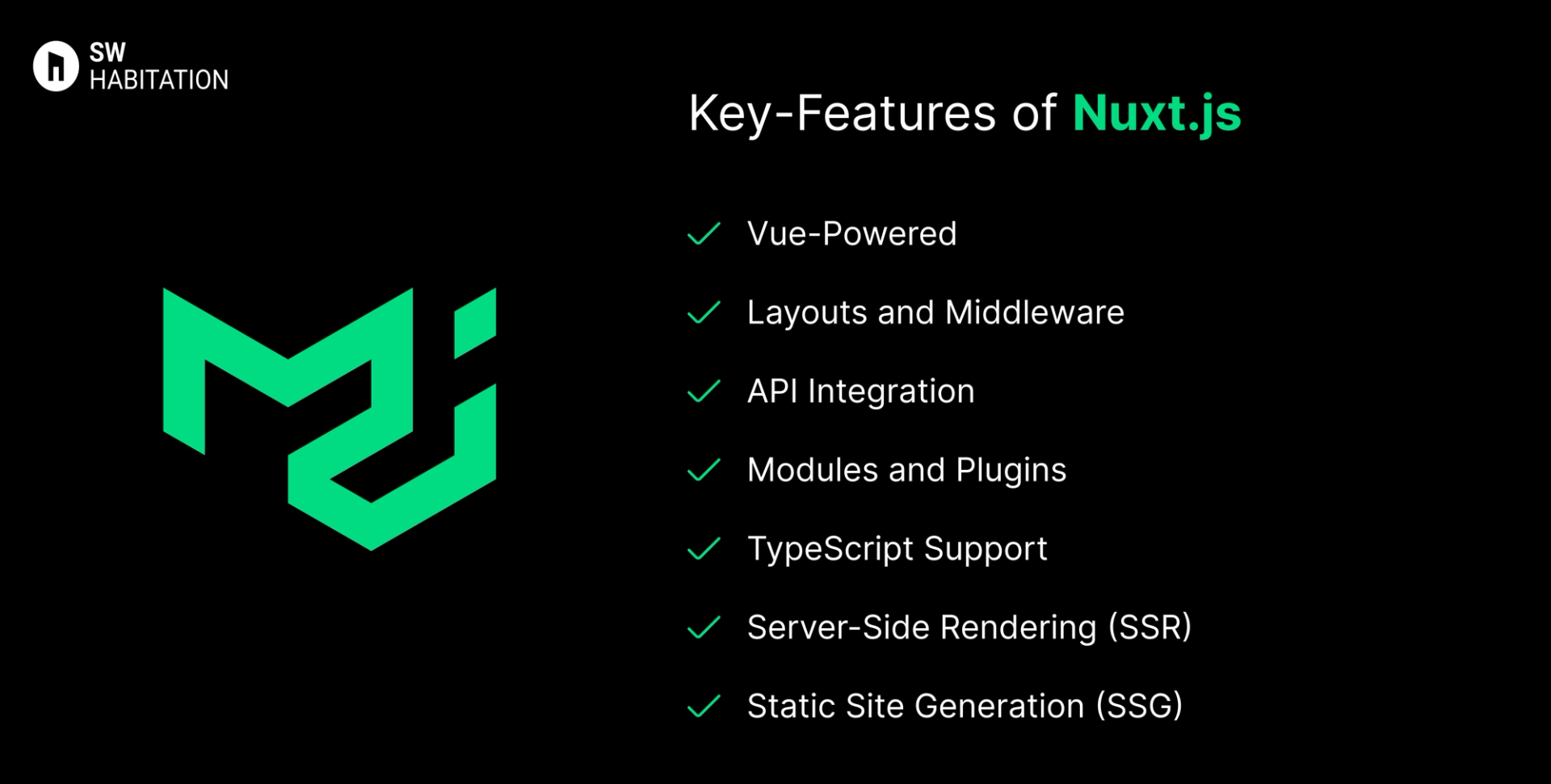
- Vue-Powered: Leverages Vue.js, making it super intuitive for Vue developers.
- Layouts and Middleware: Structure your app with reusable layouts and protect routes with middleware.
- API Integration: Easily fetch data at build time or runtime using asyncData or fetch.
- Modules and Plugins: Extend functionality with Nuxt’s huge ecosystem of modules.
- TypeScript Support: Offers built-in support for TypeScript if you prefer type safety.
- Server-Side Rendering (SSR): Boosts performance and SEO by rendering pages on the server.
- Static Site Generation (SSG): Generate static HTML pages for even faster performance.
Advantages of Nuxt.js
- Modular Architecture: Customize your app by adding only the modules you need.
- Simplified Project Structure: Organizes your app into logical folders, reducing boilerplate.
- Great Developer Experience: Hot Module Replacement (HMR) and fast build times keep development smooth.
- Versatile Rendering Modes: Choose SSG, SSR, or SPA per page to suit your needs.
- SEO-Friendly: SSR and SSG ensure search engines can easily crawl your content.
Disadvantages of Nuxt.js
- SSR Complexity: Debugging SSR issues can sometimes be tricky, especially when dealing with external APIs.
- Learning Curve: If you’re new to Vue, adding Nuxt on top can feel like a lot at first.
- Build Complexity: Projects with tons of pages may experience slower build times during static generation.
Comparison Between Meteor.js vs Nuxt js
Use Cases of Meteor.js
- Chat apps : Real-time messaging works out-of-the-box.
- Dashboards : Live data dashboards with instant updates.
- Collaborative apps : Multi-user editing apps, like Trello clone.
- MVPs & prototypes : Rapidly build and test ideas.
- Games & social apps : Real-time updates make it smooth.
Use Cases of Nuxt js
- Corporate Websites: Build fast, SEO-optimized websites with reusable components.
- Dashboards: Leverage Vue’s component system to create complex dashboards with ease.
- Blogs and Portfolios: Optimize for performance and SEO effortlessly.
- E-commerce: Use SSR to handle dynamic product pages and SSG for category pages.
Other Resources
Conclusion
Web frameworks make building websites and apps a whole lot easier. Whether you’re working on a personal project or something big for work, they help with the heavy lifting—like routing, design structure, and how everything connects.
With support for things like server-side rendering, optimized performance, and developer-friendly features, these tools let you create faster, smarter, and cleaner websites. Just pick the one that fits your style, and start building something awesome 🚀
Frequently asked questions
Is Meteor.js only for MongoDB?
Mostly yes. MongoDB is the primary database, but adapters exist for others.
Can I use React with Meteor?
Yes, React, Angular, Vue, or Blaze can be used.
Is Meteor good for production apps?
Yes, but for very large apps you might need careful optimization.
Does Meteor support real-time apps?
Absolutely. Real-time updates are built-in by default.
Why choose Meteor.js?
If you want full-stack, real-time apps fast with minimal setup, Meteor is perfect.
Is Nuxt.js free to use?
Yup, it’s completely free and open-source.
Do I need to know Vue to use Nuxt.js?
Yup, Nuxt.js is built on Vue, so understanding Vue is necessary.
Can Nuxt.js handle large applications?
Absolutely, Nuxt scales well for both small projects and enterprise-level applications.
Is Nuxt.js good for SEO?
Yup, Thanks to SSR and SSG, Nuxt ensures search engines can properly index your content.
Next blog that you can read...
By SW Habitation