
Fresh vs. Blitz.js
 By SW Habitation
Fresh

Blitz.js
So, you know when you want to build a website or app, but doing everything from scratch feels kinda overwhelming? That’s where web frameworks come in. They’re like a ready-made set of tools and building blocks that help you get things up and running way faster. Instead of figuring out every little piece yourself, a framework gives you a solid base to build on, and lets you focus on making something cool.
What is Fresh?
Fresh is a full-stack web framework for Deno that prioritizes zero JavaScript by default and leverages the islands architecture. Instead of hydrating entire pages, Fresh delivers static HTML and only hydrates isolated, interactive "islands" where needed.
Fresh is originally designed for modern edge computing with Deno Deploy, has no build step, and relies on native ES modules and TypeScript. It’s ideal for fast, lightweight, SEO-friendly apps with minimal complexity.
Key Features of Fresh
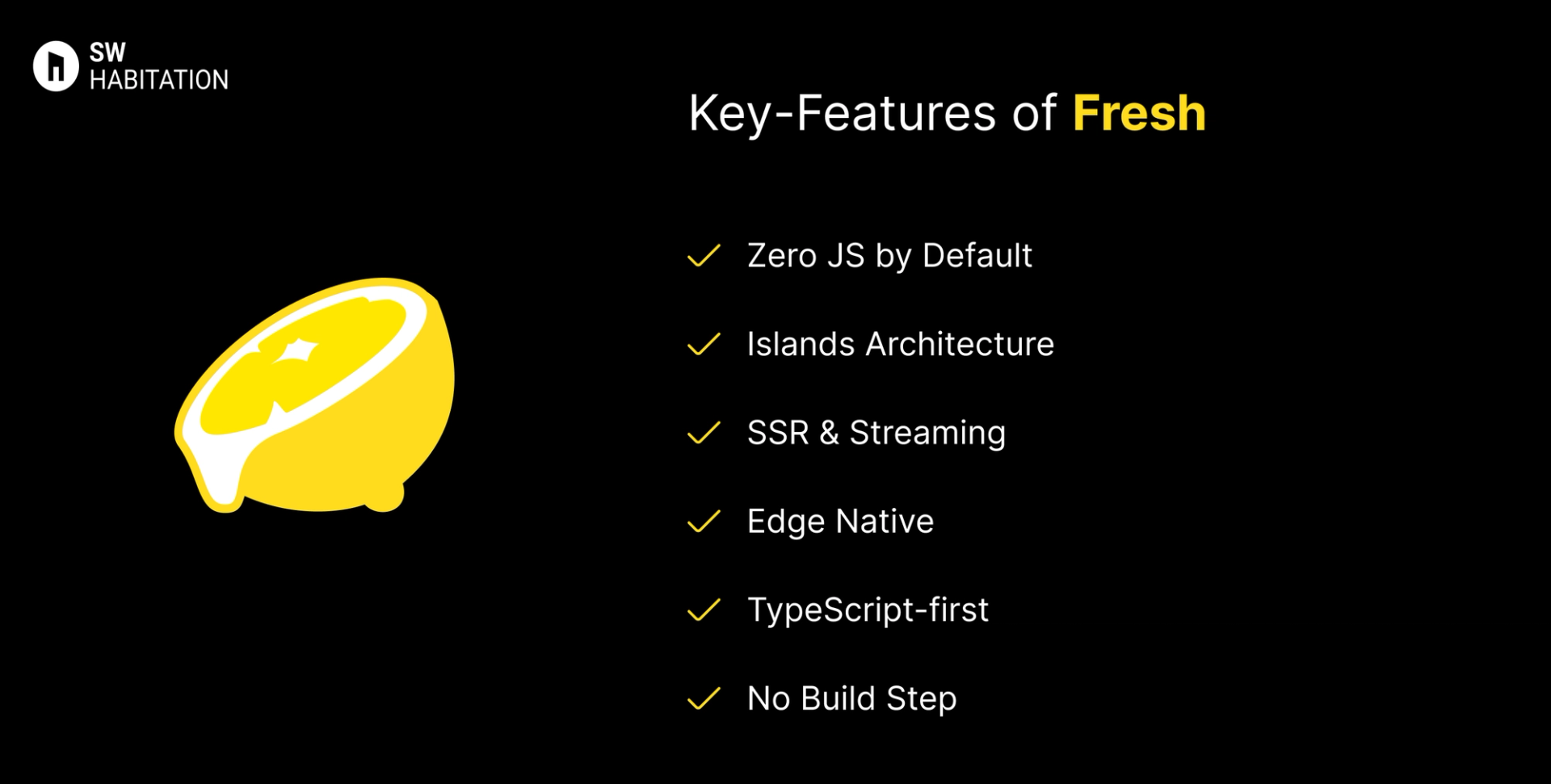
- Zero JS by Default: Ships no JavaScript unless components explicitly need interactivity.
- Islands Architecture: Interactive components exist in isolated islands for optimal performance.
- SSR & Streaming: Server-rendered HTML with support for streaming.
- Edge Native: Optimized for Deno Deploy and edge hosting.
- TypeScript-first: Built-in TypeScript support without config.
- No Build Step: Instant reloads, no bundling or transpiling.
Advantages of Fresh
- Ultra-lightweight Performance: Minimal JS means faster load times.
- No Build Step: Faster developer iteration; you write, refresh, and go.
- Edge-Optimized: Runs seamlessly on Deno Deploy with serverless scaling.
- Modern Standards: Uses ES modules, TypeScript, and Web APIs directly.
- Simple DX: File-based routing, components, and islands make development intuitive.
Disadvantages of Fresh
- Deno Only: Requires Deno runtime, limiting adoption among Node.js developers.
- Smaller Ecosystem: Fewer third-party libraries and integrations.
- Early Stage: Still maturing, not as widely adopted as Next.js.
- Custom Solutions: Some features like authentication or CMS integrations need manual setup.
What is Blitz.js ?
Imagine you wanto to build an app but setting up frontend, backend, APIs, database and it feels like overextended right ? That’s where Blitz.js comes in.
Blitz is like this super handy fullstack framework that sits on top of Next.js yup, the one you probably already know. Think of it like Rails but for React. You get Next.js goodies like (SSR, file-based routing, etc.), but Blitz throws in extra magic — like a zero-API data layer, built-in auth system, and easy database integration with Prisma.
Basically it is less boilerplate, more actual building.
Key Features of Blitz.js
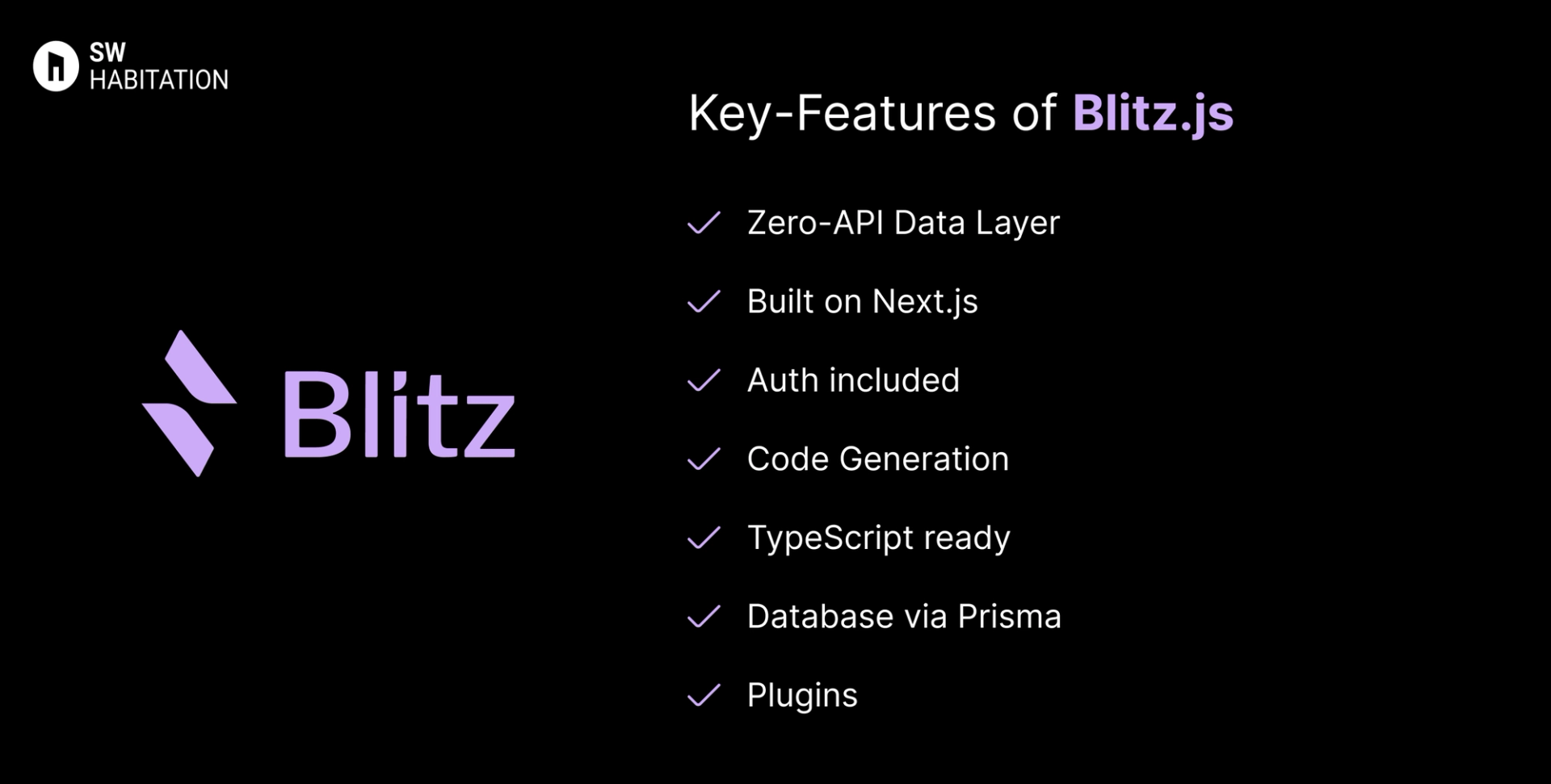
- Zero-API Data Layer – call server functions straight from the client, no need to write API endpoints manually.
- Built on Next.js – so you don’t lose all the SSR/SSG goodness.
- Auth included – login/logout stuff already sorted.
- Code Generation – scaffolding to spin up queries, pages, mutations super fast.
- TypeScript ready – works smooth with TS.
- Database via Prisma – easy database access, feels natural.
- Plugins – add common stuff like Tailwind, auth, etc. with one command.
Advantages of Blitz.js
- All-in-one: You don’t need to glue 10 tools together.
- Boosts productivity: Code scaffolding saves so much time.
- Zero-API layer: Less boilerplate, no boring API wiring.
- Still Next.js inside: You can keep SSR, static exports, etc.
- Databases: Works great with Prisma and SQL databases.
- Community is small but passionate: New recipes, ideas keep coming.
Disadvantages of Blitz.js
- Might be overkill: If all you need is a tiny static site, Blitz is too heavy.
- New learning curve: You need to understand queries/mutations instead of normal APIs.
- Smaller community: Not as huge as Next.js, so fewer tutorials and resources.
- Dependent on Next.js: Since it’s built on Next, any big shift in Next.js affects Blitz.
- Still maturing: Some features and ecosystem tools are not as polished as older frameworks.
Comparison Between Fresh vs Blitz.js
Use Cases of Fresh
- Marketing Websites: Pre-rendered, SEO-optimized pages with minimal JS.
- Blogs/Portfolios: Static sites with optional interactive islands.
- E-commerce Landing Pages: Server-rendered product data with interactive carts as islands.
- Edge-native Apps: Applications running globally on Deno Deploy.
Use Cases of Blitz.js
- SaaS apps → logins, dashboards, subscriptions, etc.
- Startups → ship MVPs super quick without boilerplate APIs.
- E-commerce → product pages, cart, checkout flows.
- Internal tools → admin dashboards, CRMs, reporting tools.
- Fullstack React apps → whenever you want frontend + backend + DB together.
Other Resources
Conclusion
Web frameworks make building websites and apps a whole lot easier. Whether you’re working on a personal project or something big for work, they help with the heavy lifting—like routing, design structure, and how everything connects.
With support for things like server-side rendering, optimized performance, and developer-friendly features, these tools let you create faster, smarter, and cleaner websites. Just pick the one that fits your style, and start building something awesome 🚀
Frequently asked questions
Is Fresh production-ready?
Yes. Fresh is stable and actively maintained by the Deno team.
Why does Fresh not need a build step?
It uses native ES modules and Deno runtime, so no bundling is needed.
Can I use npm packages in Fresh?
Fresh relies on Deno’s ecosystem. You can import npm modules using Deno’s compatibility layer.
How does Fresh compare to Qwik City?
Both focus on minimal JS, but Qwik uses resumability, while Fresh uses islands.
Does Fresh support TypeScript?
Yes. Fresh is TypeScript-first out of the box.
Is Blitz.js just Next.js with extra stuff?
Pretty much, yeah. It’s Next.js at the core but with fullstack tools (auth, DB, scaffolding, etc.) added on top.
Do I have to use Prisma with Blitz?
Nope. Prisma is the default, but you can hook up whatever database you like.
Can I still use REST or GraphQL?
Yup, you can, but Blitz’s “zero-API data layer” usually makes it unnecessary.
Is Blitz production-ready?
Totally. People already use it in production, but yeah, smaller ecosystem than React/Next.
Who should avoid Blitz?
If you’re just making a small static blog or portfolio → probably overkill. Blitz shines for bigger apps.
Next blog that you can read...
By SW Habitation