
Foundation vs. Milligram CSS
 By SW Habitation
Foundation

Milligram CSS
You know how building a website can feel like a lot, especially when you’re trying to style every little thing yourself? Buttons, forms, layouts… it adds up fast. That’s where UI frameworks really save the day. They give you a bunch of premade design elements that you can just drop in and go. It’s like having a design starter pack that helps your site look clean and professional, without spending forever tweaking the details.
What is Foundation?
Foundation by Zurb is a responsive front-end framework designed for creating responsive and accessible websites quickly. It is known for its mobile-first approach and powerful grid system, Foundation provides a set of prebuilt components and tools that help developers create professional websites, prototypes, and production-ready apps.
Foundation has been widely used by enterprises and is praised for its accessibility features that makes a solid choice for large-scale projects.
Key Features of Foundation

- Responsive Grid: Flexible 12-column grid with responsive breakpoints.
- UI Components: Includes buttons, forms, sliders, menus, modals, tooltips, and more.
- Accessibility: ARIA support and semantic markup built in.
- Sass Integration: Easy to customize with Sass variables and mixins.
- Motion UI: Built-in animation library for smooth transitions.
- Email Framework: Foundation for Emails to create responsive email templates.
Advantages of Foundation
- Theming : Sass variables, mixins, and functions allow deep but easy customization.
- Consistency : Provides a consistent design system for teams working on large projects.
- Accessibility : Built-in ARIA support and WCAG compliance for inclusive websites.
- Grid System : Responsive, flexible grid with custom breakpoints for any screen size.
- Mobile-First : Designed with a mobile-first approach, ensuring layouts work on small screens first.
- Components : Includes a wide range of prebuilt UI components like buttons, forms, menus, and modals.
- Professional Use : Trusted by enterprises and large projects where stability and accessibility matter.
- Integration : Plays well with modern build tools (Gulp, Webpack, npm) for scalable workflows.
- Responsive Emails : Comes with Foundation for Emails to create mobile-friendly email templates.
Disadvantages of Foundation
- Design Opinionated : Prebuilt components feel dated compared to newer UI frameworks.
- Support : Fewer active tutorials, blog posts, and YouTube guides compared to Bootstrap.
- Learning Curve : More advanced setup and Sass knowledge needed, unlike Bulma or Bootstrap.
- Weight : Bigger in size than minimal CSS frameworks, which can affect performance.
- Popularity : Less adoption in recent years compared to Bootstrap or Tailwind CSS.
- Community : Smaller user base and fewer third-party themes or extensions.
- Complexity : Might be overkill for small projects that don’t need advanced features.
- Documentation : Feels less beginner-friendly and not updated as frequently.
What is Milligram CSS?
Milligram CSS is a minimalist CSS framework that weighs in at just 2KB gzipped, making it one of the lightest options available for developers who value speed and efficiency. It follows a clean, modern design approach with sensible defaults, so you can get started quickly without having to overwrite a ton of styles. Milligram uses the flexible grid system powered by Flexbox, making layouts intuitive and responsive right out of the box.
What makes Milligram stand out is its balance between simplicity and usability. Unlike heavier frameworks, it doesn’t come bundled with unnecessary UI components, which keeps your project lean and fast.
Key Features of Milligram CSS
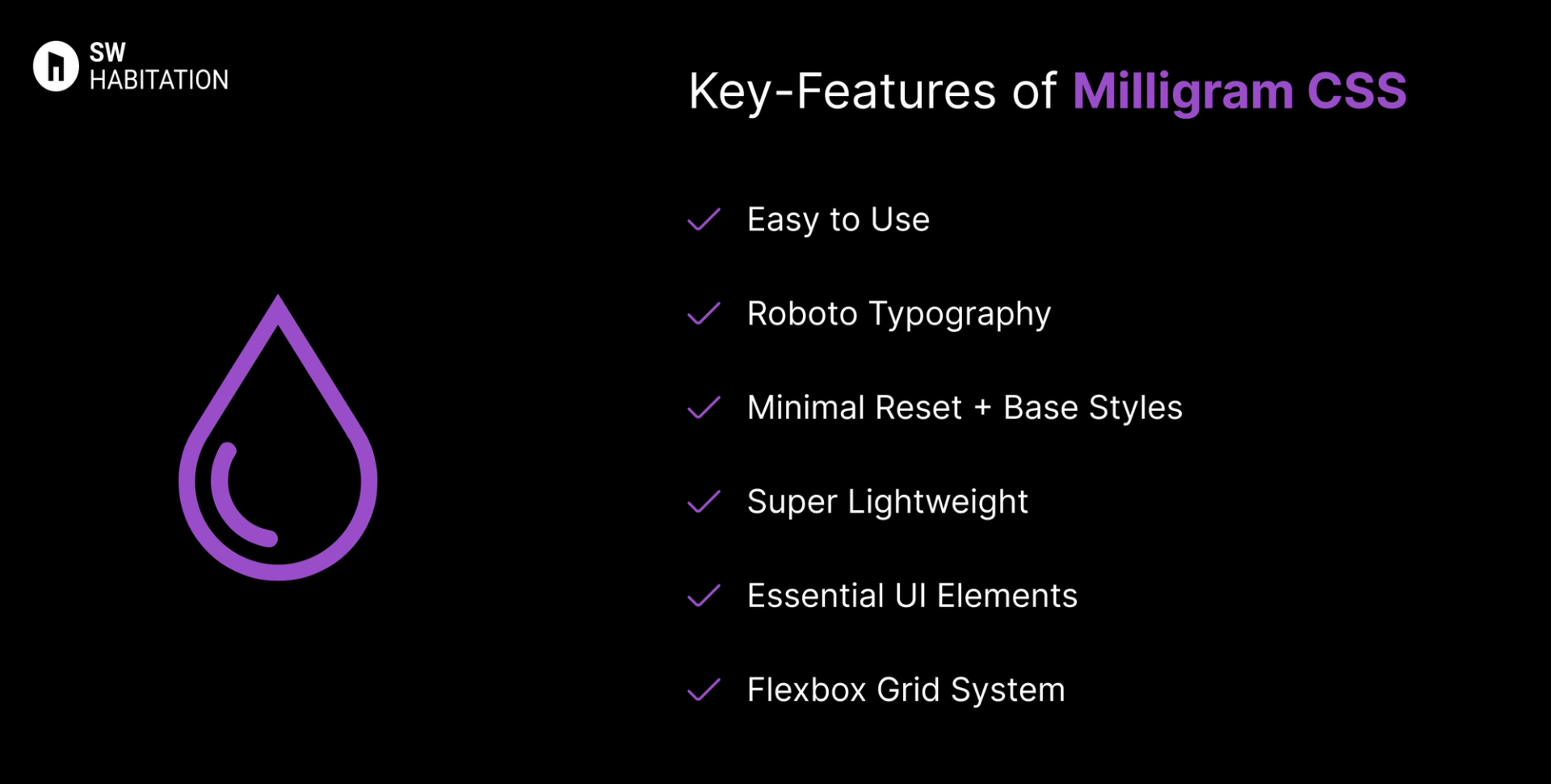
- Easy to Use: Available via npm, Yarn, Bower, CDN, or CLI starter projects for quick setup.
- Roboto Typography: Uses Google’s Roboto font for clean text styling; easy to override if needed.
- Minimal Reset + Base Styles: Comes with normalization and essential styles for clean coding.
- Super Lightweight: Just ~2 KB when gzipped, making it lightning-fast.
- Essential UI Elements: Includes styles for typography, buttons, lists, forms, tables, blockquotes, grids, and utilities.
- Flexbox Grid System: Responsive, flexible layout using modern Flexbox, with customizable max width.
Advantages of Milligram CSS
- Ultra Lightweight: Minimal file size ensures speedy load times.
- Quick Setup: Plug-and-play means just include the CSS and you're good to go.
- Clean Base Style: Neutral, design-agnostic foundation for custom styling.
- Modern Layouts: Flexbox grid offers flexibility and responsiveness.
- Ideal for Prototypes: Great when you need a fast, clean UI baseline.
- No Build Required: Works without any preprocessing or configuration.
Disadvantages of Milligram CSS
- Not for Complex UIs: Best suited for simple layouts, not rich interactive interfaces.
- Limited Components: Does not include advanced UI like modals, dropdowns, or navbars.
- Smaller Ecosystem: Fewer templates, plugins, or community resources available.
- No JavaScript Support: Pure CSS, interactivity must be built separately.
- Typography Dependency: Defaults to Roboto, adds an external request unless changed.
Comparison Between Foundation vs Milligram CSS
Use Cases of Foundation
- Websites needing advanced UI components with JS integration.
- Projects needing responsive emails + websites.
- Large-scale projects with complex layouts.
- Enterprise websites requiring accessibility.
Use Cases of Milligram CSS
- Landing Pages: Fast, mobile-friendly, and performance-focused.
- Educational Projects: Beginner-friendly for learning CSS.
- Minimalist Web Apps: For simple, fast, and lightweight projects.
- Quick Prototyping: Build clean UI prototypes quickly.
- Performance-First Sites: Perfect for JAMstack/static sites.
Other Resources
Conclusion
UI frameworks make building a polished website way easier. Whether you're working on something simple or a big project, they help you get things looking just right without having to stress over every little design decision. With ready-to-use components, responsive layouts, and modern styles, you can build faster and smarter.
So, pick one that works for you, and start creating a site that looks amazing from the get-go.
Frequently asked questions
What is Foundation CSS?
Foundation is a responsive front-end framework by Zurb, used to build mobile-first, accessible websites.
How is it different from Bootstrap?
Both are popular, but Foundation is more flexible, Sass-driven, and has stronger accessibility features.
Is Foundation mobile-first?
Yes, its grid and components are designed with mobile-first responsiveness.
Can I customize Foundation easily?
Yes, it’s built with Sass, so you can tweak variables, colors, and components.
Does Foundation support accessibility?
Definitely. It includes ARIA support and a11y-friendly components out of the box.
Is Milligram completely free?
Yes, Milligram is open-source and distributed under the MIT license.
How do I include Milligram in my project?
Install via npm/yarn/bower, use the CDN link, or leverage the Milligram CLI to generate a simple boilerplate.
Do I need any build tools to use Milligram?
Nope, just include the CSS file in your project’s <head> and you're set.
What is Milligram best suited for?
It’s ideal for quick prototypes, clean documentation pages, landing pages, and any performance-sensitive project looking for a minimal styling foundation.